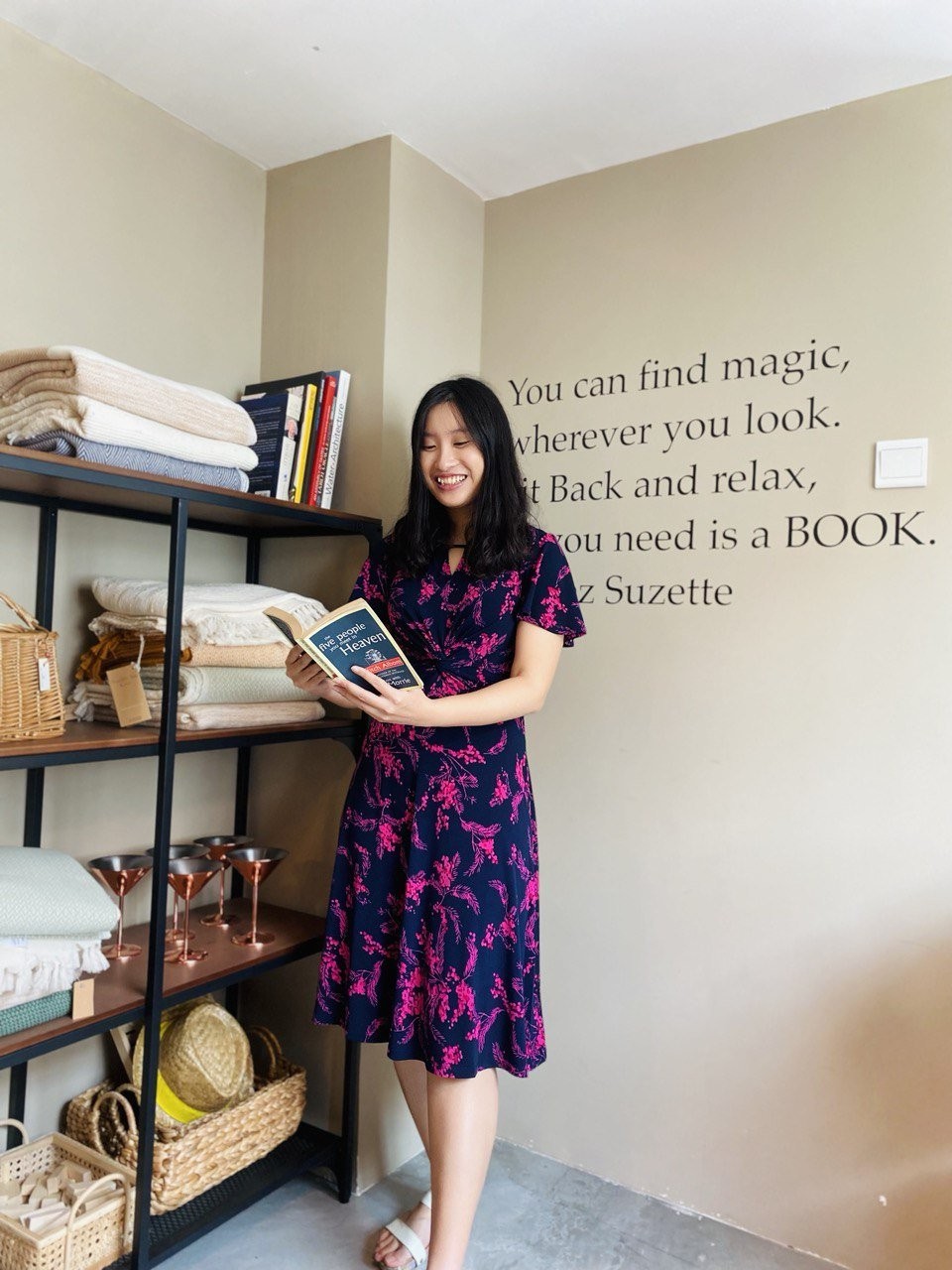
This month, Sahtu Press is beginning an all-new interview series with Southeast Asian writers across the globe to assist intercultural conversations on what it means to be creating in our modern times, finding our own voices, and reaching towards the outermost limits of our imagination. In 2022, we met several in person for the very first time at the international Singapore Writers Festival, including the writer Sarah Ang who graciously agreed to be the very first writer for this project.
Sarah Ang grew up in Singapore and graduated from University College London, where she studied English Literature. She has won multiple international awards for her writing, including first place in the Wilbur Smith Author of Tomorrow Award, first place in the iYeats Poetry Competition (Emerging Category), first place in the National University of Singapore Creative Writing Competition, second place in the Walter Swan Poetry Prize, second place in the Alpine Fellowship Academic Writing Prize. Her work has also been featured in publications including Mithila Review, Alexandria Quarterly, Eunoia Review, Quarterly Literary Review Singapore and Idle Ink, among others. Find her at www.sarahangwrites.com.
Can you tell us a little about yourself, and how did you develop an interest in writing?
Right now, I write both poetry and short stories. I began submitting my work to competitions and literary journals when I was fifteen, and was pleasantly surprised when they received recognition.
I was a voracious reader as a child, which definitely influenced my writing - swept up in the worlds I found in books, I itched to write stories of my own.
I have been writing for as long as I can remember. My early works, written when I was around five, ranged from poems about oranges to short stories about imaginary adventures in faraway places with my brother and cousins (think Enid Blyton’s Famous Five). In primary school, when I was about nine, I co-wrote a story with my best friend. We were in different classes, but we would pass a notebook back and forth and take turns continuing the story from where the other left off. I remember, even then, feeling a thrill when I thought of a new idea, and the sense of satisfaction in bringing it to fruition. It’s this feeling that compels me to write: new characters and ideas clamour for my attention, and they won’t let me rest until their story is told.
What are some of your favorite things to study, and how has this influenced your approach to writing?
Lots of things! I would say, first and foremost, I am a student of the world around us. As Shakespeare says, all the world’s a stage, and all the men and women merely players. We are all characters in the play of life. I like to observe dynamics between people, how they interact with each other, and what makes them tick. My stories and poems try to capture that - be it a daughter’s yearning for her mother, the insoluble bond between siblings, or lovers on the cusp of a budding relationship. In that same vein, I am a student of light, forever trying to strain at what Keats terms ‘particles of light in a great darkness’ and give voice to both the moments of light-filled joy and the dark desolation that light’s absence creates.
I’ve also taken to studying nature during long, meandering walks in parks. Singapore’s parks are regrettably underrated, I feel. What they lack in size, they make up for with soul - and remarkably well-positioned signs educating you about resident flora and fauna. Becoming more attuned to nature has helped me become more observant to detail, which can be seen in my writing, I think.
Who do you turn to for your literary inspirations?
Carol Ann Duffy has been a huge inspiration. Her collection “The World’s Wife", with its imaginings of wives and partners of commonly known figures from the realm of fairytale, history or literature, such as Queen Herod, Mrs Aesop, Mrs Beast and Queen Kong, showed me how you could breathe life into old tales by putting a new spin on them. I love the lyricism and vivid imagery in Sharon Olds’ collection Stag’s Leap. Ocean Vuong is another poet I admire - I hope to one day be able to imbue my poems with half as much raw emotion as he does.
Toni Morrison’s work has also had an indelible impact on me, with the hard-hitting themes she grapples with through the lens of human relationships.
I think Celeste Ng also does this really well - she’s got a remarkable knack for letting you feel for characters.
I could go on, but then we’d never finish this interview!
What do you aim to achieve with your writing?
As a child growing up in Singapore, my literary influences were heavily drawn from Western culture. I grew up reading books featuring characters with blonde hair and blue eyes, going on adventures in foreign lands and eating strange foods, instead of characters I could relate to – ones who looked like me or lived in places I was familiar with. Even now, having both studied English literature at the undergraduate level in University College London (UCL), and taught the subject as a relief teacher in my alma mater in Singapore, I am acutely aware that the study of literature, and the production of creative works, still largely revolve around the Western world. My booklist at UCL consisted almost entirely of works by dead white male authors, with only a smattering of works by writers of African origin, and hardly any Asian writers, despite calls by students for a more diverse curriculum.
My goal as a writer is to change that. I hope to write stories that introduce non-Western, and more specifically, Asian culture and myth to a wider audience.
What are some of the pieces you’ve written that you're excited about?
In my fictional piece “Fox Spirit”, which won second place in the International Walter Swan prize, I challenged the myth of the hulijing, traditionally depicted as a malicious spirit which assumes the form of a beautiful woman to seduce men and consume their souls. My piece subverted this myth by depicting the tragic past of the hulijing at the hands of men, as well as her eventual resurgence as a powerful deity-like being, providing a more sympathetic portrayal of her actions. Similarly, my story ‘Pearl Diving’, which won first place in the Wilbur Smith Author of Tomorrow Writing Prize, was inspired by the COVID-19 pandemic, and borrowed from the tales of ama, or Japanese pearl divers, transplanting their story into a world ravaged by deadly disease.
What's the best compliment you've received for your writing so far?
My friend M read my story “Pearl Diving” which won the Wilbur Smith Author of Tomorrow prize, and bawled. To know that my writing had the power to move people to tears was really gratifying to me.
What's one of the most unusual subjects you've taken on with your writing?
I wrote a story “The Tiger Sisters,” which was inspired by the myth of “harimau jadian”, or humans who could shape shift into tigers. The story imagined an alternate history of colonial-era Singapore, where as the British hunted down and exterminated tigers, two were-tiger sisters struggled to fight for survival while defining their own identity and relationship with each other.
What’s next for you?
I hope to one day write a novel, or a poetry collection. Hopefully both.
You can follow more of Sarah’s adventures at www.sarahangwrites.com!